YEAR 2000 SOLUTIONS FOR
NATURAL(tm)
- Translation of legacy dialects of Natural to Natural 2.x Structured
- Identification of date fields based on portfolio-wide control and data flow analysis
- Population of a comprehensive relational database repository to support analysis of Natural source code.
- Partitioning of Natural portfolios to simplify Year 2000 project scheduling
- Remediation of Year 2000 date defects
________________________________
NXL provides an automated translation of legacy source code to Natural
2.x Structured. During this translation phase, the original source code
is parsed and analyzed. The source code syntax is then modified by the
automated application of a suite of transformation rules to produce
structured-mode
syntax compatible with the latest release of Natural. Items requiring post
translation manual review (typically <1%) are clearly identified in
the output source code and summarized in reports.
The NXL basic translation technology is proven and has been used to
upgrade over 35 million lines of MVS(tm), VMS(tm),
and UNIX Natural source code for 30+ satisfied customers worldwide.
Its flexible architecture allows straightforward incorporation of
client-specific
transformation rules that provide added-value services such as code
rationalization,
standards enforcement and dead code removal.
________________________________
NXL2000 identifies date fields accurately and
consistently through its extensive understanding of both the meaning
and behavior of all Natural module types. Detailed
parsing and heuristic rules are used to identify date fields based on formats,
usage patterns, and naming conventions. Semantic analysis rules
are then applied to trace the flow of date fields within individual programs
and throughout the application portfolio. This is essential because semantic
analysis identifies date fields which may have been missed by the basic
rules and provides corroborating evidence for those already identified.
NXL2000 is extensible and can be customized to accommodate client-unique naming conventions and multiple national languages.
Formal Systems offers two levels of impact analysis as illustrated in Table 1.
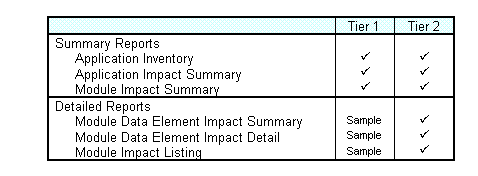
TABLE 1
The detailed reports can be provided in a variety of formats. Among
these, programmers generally find HTML format to be the most useful. As
shown in Figure 1, date defects are easily identified in the source code
when bolded.
________________________________
The NXL2000 Repository supports the generation of standard and ad-hoc reports spanning all applications within a client portfolio. These reports can be used for:
- Application and module coupling analysis
- Portfolio-wide control and data flow analysis
- Project management and scheduling of resources
- Generation of test strategies
The NXL2000 Repository is delivered with a standard set of reports which
can be extended using ad-hoc query tools. Among its key features is an
interactive flow diagram of the application portfolio. This tool allows
the project team to view the relationship between portions of the portfolio
as needed. Queries can also be run against the flow diagram to isolate
specific components of an application portfolio.
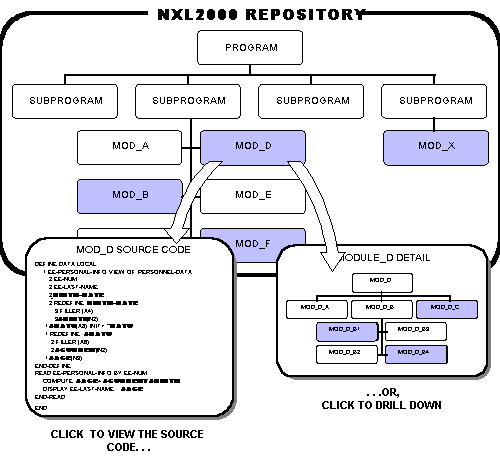
FIGURE 1
________________________________
The NXL2000 Repository supports selection and implementation of partitioning strategies based on:
- Application - A partition defined by the complete set of modules associated with an application
- File usage - A partition defined by the set of modules accessing a common set of files or fields
- Global field usage - A partition defined by the set of modules which share global fields and other common field declarations, such as LDAs and PDAs
- Control flow - A partition defined by the set of modules which call or otherwise reference each other
- Library relationships - A partition defined by the set of modules in the source LIBRARY including STEPLIBS
Commonly used partitioning techniques, based on library or module names, typically overlook subtle relationships between application components. With the detailed information available from the NXL2000 repository, even very large application portfolios can be efficiently and accurately partitioned.
________________________________
Performance
Guarantees
NXL2000 supports customer-specific remediation strategies including:
- Full field expansion - Date fields in the database and source code are expanded. Screens and reports are adjusted to allow for input and display of the expanded date fields.
- File and logic expansion/interface windowing - Date fields in the database and program logic are expanded but screen and report fields are left in their short form with date windowing applied to input values. Output values are truncated.
- Logic windowing - Date fields in the database and on screens and reports are left in short form with date windowing applied in the program logic when date values are processed.
NXL2000 supports multiple remediation strategies within the same
application
portfolio. As a result, strategies can be tailored to meet client-specific
requirements.
________________________________
The performance of NXL2000 is guaranteed.
- Date field identification error rates are less than 1% false negatives and less than 5% false positives.
- Date field remediation coverage is greater than 75%.
FSI provides a full unconditional refund if NXL2000 fails to meet these
standards.
________________________________
No Risk Demonstration
Copyright © 1997 by Formal Systems Inc. All rights reserved.
Natural is a registered trademark of Software AG, Darmstadt, Germany.
MVS is a registered trademark of International Business Machines Corporation.
VMS is a registered trademark of Digital Equipment Corporation.
 To the Year 2000 Information Center™